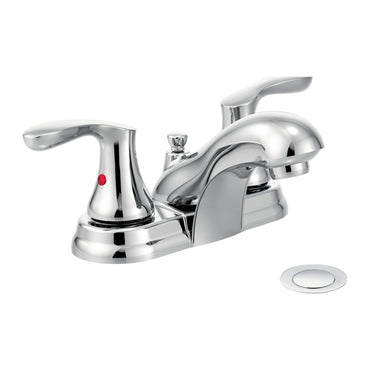
Quick answer: Moen vs Pfister is primarily a question of what fits your existing plumbing. For a sink, either brand can work if the faucet matches your mounting holes, counter thickness, and water-supply connections. For a shower, the trim and cartridge must match the specific valve inside the wall; Moen and Pfister shower parts do not normally interchange. Replacing a complete sink faucet is usually simpler than changing an in-wall shower valve.
For a sink replacement or remodel, start with the hardware you will keep. Browse bathroom faucets for your sink layout after counting the mounting holes.
For a shower update, the valve behind the handle determines which trim attaches. Some jobs need only front-of-wall access; others involve opening the wall.
What Decides a Moen vs Pfister Purchase?
A Moen vs Pfister purchase depends on the sink openings, supply fittings, and shower valve you have. A sink may accept either brand, but an existing shower rough-in limits which trim fits.
A complete sink faucet can replace another brand if the mounting and supply connections fit. Cartridges, handles, and shower trim are more specific: similar lever shapes do not establish a match.
Choose the scope first: a dripping spout may need a cartridge, a damaged escutcheon may need matching trim, and a new shower valve family requires pipe work. Replacing a worn handle alone makes sense only if the valve operates correctly.
How Do You Identify the Existing Fixtures?
Identify an existing fixture by its maker marking and mounting connections without opening a pressurized valve. Look on the sink spout base, handle, underside, or shower trim plate for a name or logo; lever shape alone is not enough.
For a sink, photograph the mounting nuts, hoses, shutoffs, and any labels under the cabinet. Remove the old deck plate only after disconnecting the faucet; it can conceal unused holes.
For a shower, photograph trim screws, markings, and handle movement. Cover the drain before removing the handle with a hex key or screwdriver, and do not loosen a cartridge retainer while the water is on.
What Should You Measure Before Buying?
Measure the sink mounting pattern and shower wall opening before ordering. Record the following with a tape measure, flashlight, and phone camera.
- Count the sink or countertop mounting holes, including any hidden beneath the existing deck plate.
- Measure the center-to-center distance between the outermost sink holes, each hole diameter, and the countertop thickness.
- Measure the distance from faucet mounting center to the basin and the clearance behind the faucet for the lever and mounting hardware.
- Check the shutoff valve outlets and hose ends for 3/8-inch compression or 1/2-inch IPS connections, and note any damaged shutoff.
- Photograph the shower valve markings, exposed stem shape, cartridge retainer, and trim screw positions after removing the plate.
- Measure the existing shower escutcheon diameter, exposed wall opening, and position of the valve stem relative to the finished wall.
Center-to-center means hole middle to hole middle, not edge to edge. New shower trim must cover any exposed tile damage without blocking the valve fasteners.
How Moen vs Pfister Faucets Fit Your Sink
Complete bathroom sink faucets follow the same selection rules: match the number and spacing of mounting holes, then connect the supplies correctly. One-hole faucets mount at a central opening, while a three-hole installation can use a connected centerset base or separate widespread spout and handles.
Compact three-hole sinks commonly have four-inch centers; widespread layouts often have eight-inch centers, but hole spacing varies. For a Moen vs Pfister bathroom faucet comparison, measure outer hole centers and the width of any plate covering unused holes.
Identify the shutoff outlet size and faucet hose ends under the cabinet. Not every faucet includes the same hoses or accepts rigid risers; replace a damaged shutoff before installation.
Measure from the mounting center to the basin to estimate where the water lands, and leave clearance behind the lever. If a drain is included, match its overflow arrangement to the sink.
The Moen vs Pfister Shower Valve Decision
The installed shower rough-in body determines which cartridge and trim can attach without changing the hot and cold piping behind the wall. A rough-in is not a trim plate: the cartridge sits in that body, and the handle and escutcheon attach to its particular mounting arrangement.
Moen Posi-Temp and M-CORE are distinct valve systems, and Pfister has its own valve families. Matching finishes and similar screw spacing do not establish compatibility. Identify the valve and cartridge form before choosing the trim family.
For a finish change, keep a working rough-in and select trim specified for it. Switching systems requires access to the cavity, pipe reconnections, and the correct finished-wall depth.
A tub-shower also needs the correct spout and diverter arrangement; shower-only trim cannot serve both outlets. Look for a pull-up diverter on the tub spout or a separate diverter control at the wall before selecting the replacement.
Which Existing Shower Parts Can Stay?
A working shower rough-in can stay when its cartridge and trim family support the replacement you want. If the shower drips while off or becomes difficult to operate, the cartridge may need replacement; the external handle alone will not fix worn internal seals.
Cartridges do not generally interchange across brands, and retainers differ within each brand. Shut off the water, remove the handle, and compare the complete cartridge and its retaining clip or nut; stop if the valve body twists or the retainer sticks.
Tub spouts need a separate connection check. A slip-fit spout uses a set screw under the spout on smooth copper; a threaded spout screws onto a pipe nipple. Identify the attachment and measure the exposed pipe length, because a replacement spout may need a different pipe length or adapter.
What Should You Buy for Each Project?
Buy a complete sink faucet for matching holes, shower trim for a retained valve, or a rough-in-and-trim set for a valve change. Use the table to select the job.
| Your Existing Setup | Buy or Replace | Wall Opening Needed? |
|---|---|---|
| One sink hole | Single-hole faucet with a matching mounting shank | No |
| Three closely spaced sink holes | Correct three-hole faucet, or single-handle faucet with a plate that covers unused holes | No |
| Three separate, wider sink holes | Widespread faucet with separately mounted spout and handles | No |
| Working Moen Posi-Temp valve | Matching Posi-Temp trim for shower-only or tub-shower use | Usually no |
| Working Moen M-CORE valve | M-CORE trim specified for the installed M-CORE valve | Usually no |
| Existing Pfister valve, new Moen system wanted | New Moen rough-in plus its matching trim | Usually yes |
For a compact sink, the WSL84502SRN Adler has a low-arc spout, one handle, and 1/2-inch IPS connections. Confirm its mounting layout on the Moen spec sheet and check that your countertop is within its 1-3/4-inch maximum mounting thickness.
For a higher spout with a single lever, the 84303SRN Hamden includes an optional three-hole deck plate, a push-down waste assembly, and flexible supply lines with 3/8-inch compression fittings. For separate handles, the 84764SRN Genta requires three mounting holes at least one inch in diameter and 1/2-inch IPS flexible-hose connections; do not connect rigid or semi-rigid risers to it.
For an existing compatible Posi-Temp tub-shower valve, the TL183EP Chateau is chrome tub-and-shower trim with a 6-1/2-inch round escutcheon and a 4-1/2-inch wall-opening reference. For a Posi-Temp shower without a tub spout, the T2812NHBL Rizon is matte black shower-only trim without a showerhead, so plan for the showerhead separately.
For an M-CORE 2-Series shower, the UT2282EPBN Dartmoor includes an eight-inch rainshower head, arm, and flange in a brushed nickel shower-only configuration. Choose it only for the appropriate M-CORE setup rather than for an older Posi-Temp or a Pfister body.
Which Installation Jobs Need a Plumber?
A sink faucet swap can be a homeowner job; replacing an in-wall shower rough-in usually needs a plumber. You need a basin wrench, adjustable wrench, bucket, and working hot and cold shutoffs.
Close both shutoffs, open the faucet to relieve pressure, and place a bucket under the hoses. Disconnect the hoses, undo the mounting nuts, and lift out the faucet; clean the deck and mount the replacement with its gasket. Attach hoses without kinks, reopen the shutoffs slowly, and inspect each connection while water runs and after it stops.
For a drain replacement, match the sink overflow and trap connection; fill and empty the sink while watching for leaks. If a shutoff will not close, stop before loosening a supply line.
Installing matching shower trim is usually a front-of-wall job; protect the drain and isolate the water before cartridge work. Ask a plumber to handle failed shutoffs, seized cartridges, hidden leaks, or rough-in pipe connections. The plumber should set the valve depth, support the piping, and pressure-test joints before closing the wall.
For a Moen vs Pfister decision, keep the existing shower valve if you want a finish change and can identify its matching trim. Choose either brand for a sink only after measuring the holes and supply ends. For a complete shower remodel, buy the valve and its trim as a matched system and plan access for the piping. Do not order visible trim by appearance alone.
Frequently asked questions
Is Moen or Pfister Better?
Neither brand is universally better for every bathroom. A sink faucet should suit your mounting holes and supply fittings; a shower trim should match the valve already installed.
Are Moen and Pfister Parts Interchangeable?
No, their shower cartridges, handles, and trim generally are not interchangeable. Standard sink supply fittings may allow complete faucets from either brand to connect to existing shutoffs, but that does not make internal repair parts interchangeable.
Which Brand Has Easier Replacement Cartridges?
Cartridge service depends on the particular valve family, retainer design, and mineral buildup rather than the brand alone. Identify the cartridge and water shutoff first; some cartridges require a dedicated puller if they are stuck.
Do Moen and Pfister Use the Same Valve?
No, they use different shower rough-in systems. Keep the existing valve and purchase matching trim, or replace the rough-in and reconnect the piping to switch systems.
Which Brand Is Easier to Install?
A sink faucet with matching holes and supply fittings is usually the easier installation regardless of brand. Replacing either brand's shower rough-in involves more work because the valve connects to piping inside the wall.
Ready to choose? Browse our Bathroom Faucets collection at Aqualux Studio.
Related reading
- Moen vs Delta: Choose Shower Valves, Cartridges, and Trims
- Moen vs Kohler: Compare Sink Faucets, Shower Valves and Trims
Written by John Plumber, an experienced plumber who shares his personal opinion and hands-on experience.
This article reflects personal experience, not step-by-step instructions. Always follow the manufacturer's installation guide for your exact model, and hire a licensed plumber if you are not sure. Questions or corrections: support@aqualux.studio.