

Quick answer: Replace the cartridge inside the Moen Roman tub faucet to stop drips, fix stiff handles, and restore full shut-off. First, identify whether the leak comes from the hot or cold side by shutting off each supply; a stopped drip pinpoints the faulty side. Remove the handle, note cartridge orientation, pull it out with a cartridge puller if seized, greasing the new O-rings before seating the replacement.
If your Moen Roman tub faucet drips from the spout, a handle turns stiffly, or the water won't fully shut off, a roman tub faucet cartridge replacement is usually the right fix. A cartridge is the inexpensive part that controls flow inside each handle, and swapping it rarely takes more than an hour. A new trim makes more sense when the visible parts are worn out. That includes a corroded or pitted finish, a cracked spout, stripped handle connections, or a look you are ready to retire. In that case, a new trim can go onto the valve body that is already installed under the deck.
To compare the models while you read, see the Moen Roman tub faucets we have in stock.
The key is that the valve stays in place either way. Moen Roman tub faucets are built as a rough-in valve mounted below the deck plus a trim that sits on top. Once you know which valve you have, you can choose between a repair and a full trim swap without opening walls or cutting tile.
-

 13% off
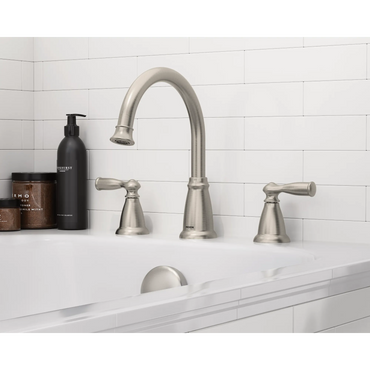
MOEN 86440BRB Caldwell Mediterranean Bronze Two-Handle High Arc Roman Tub Faucet
$168.95$168.95 $194.98 -


Quick roman tub faucet cartridge replacement diagnosis
Start by noticing where the problem shows up. A steady drip from the spout with both handles closed almost always points to a worn cartridge seal on the hot side, the cold side, or both. To find out which one, shut off the hot supply under the tub access panel. If the drip stops, the hot cartridge is the culprit. Then repeat the test with the cold supply.
Water seeping out around the base of a handle usually means a failed O-ring on the cartridge, not a failed valve. A handle that grinds, sticks, or needs extra force to turn often has mineral buildup on the cartridge. Weak flow from the spout can come from debris trapped at the cartridge inlet or in the supply lines. None of these symptoms means the valve body itself is bad.
Problems that do point beyond the cartridge include water pooling under the deck at the valve body, cracks in the valve casting, and threads that no longer hold the cartridge snugly. These are less common, but they change the decision entirely.
| Issue | Cartridge Fix | Trim Fix |
|---|---|---|
| Dripping spout | Replace hot or cold cartridge; test supplies to locate side | Not needed unless finish is damaged |
| Stiff handle | Clean mineral buildup; replace cartridge if O-ring failed | Replace trim if handle splines stripped |
| Worn finish (flaking chrome, etching) | Cartridge replacement won’t improve appearance | Install new trim (e.g., T4943BN) for fresh surface |
| Cracked spout or hairline crack | Cartridge won’t fix structural damage | Swap trim with new spout |
| Repeated cartridge repairs | Replace both hot and cold cartridges as matched pair | Consider new trim if hardware aging |
| Style change or remodel | Cartridge swap retains same look | Choose new trim matching desired finish and spout reach |
When a cartridge alone is enough
If the trim still looks good and the handles attach firmly, replacing the cartridges is the most economical path. Most two-handle Roman tub valves use separate hot and cold cartridges that rotate in opposite directions. Replace them as a matched pair, even if only one is leaking. The second one has seen the same water and the same years of use, and you will avoid taking the faucet apart twice.
Before you start, turn off the supply stops or the main shutoff. Remove the handle and escutcheon, and note the orientation of the old cartridge before pulling it out. Clean the valve seat with a soft cloth, apply a thin coat of silicone plumber's grease to the new O-rings, and seat the cartridge fully before tightening the retaining nut. If a cartridge has seized from scale, a cartridge puller tool is far safer than prying it out with pliers.
Homeowners who handle repairs on several fixtures sometimes keep a general service assortment on hand. The 104630 commercial service kit is one option for keeping common small parts within reach. Always confirm that a kit's contents match your specific valve before relying on it.
Clear signs a new trim is the better buy
A new trim earns its cost when the problem is cosmetic or structural, not internal. Flaking chrome, oil rubbed bronze that has worn through to bare brass, or brushed nickel with permanent water etching will not improve with a new cartridge. The same goes for a spout with a hairline crack, handles whose splines have stripped, or escutcheons that no longer sit flat against the deck.
Repeat repairs are another signal. If you have already replaced cartridges once and the trim is also showing its age, putting new internals behind tired metal can feel like throwing good money after bad. A remodel or finish change is the third case. Swapping to new hardware lets you match updated cabinet pulls, lighting, or a new shower trim without disturbing the plumbing.
In most cases, a replacement trim comes with its own new handles, spout, and escutcheons. If you buy one, you are effectively refreshing every visible surface at once.
Identifying the valve under your deck
Begin with the series name. It is often printed on the original paperwork, and the spec sheet for that series lists the required rough-in. Next, look at the valve type. Deck-mounted Roman tubs typically use a dedicated two-handle Roman tub rough-in. Posi-Temp and Moentrol are pressure-balancing valves for showers and tub-shower combinations in the wall. M-CORE is Moen's newer platform that covers several configurations. If your tub faucet is really a wall-mounted single-handle control, you are dealing with one of those wall valve systems, not a deck-mount Roman tub valve, and the trim must match that system instead.
Measure the spread between the centers of the hot and cold handle holes. Roman tub valves commonly accommodate spreads somewhere in the range of about 8 to 16 inches, and many allow some adjustment. The exact range depends on the model, so check the spec sheet. Also check deck thickness, since every valve has a maximum it can clamp through.
Finally, look at the inlets through the access panel. Typical connections are half-inch sweat for copper, half-inch threaded IPS, or PEX. The connection type matters if you ever replace the valve, but for a trim-only swap the important point is that the trim is listed as compatible with the existing rough-in.
Choosing a compatible Moen trim
Once you know your valve, look for a trim whose spec sheet names it as the required rough-in. If you have a standard two-handle Roman tub valve and want a traditional look, the Brantford line is a straightforward choice. The T4943BN delivers a low-arc spout in brushed nickel. The T4943ORB offers the same design in oil rubbed bronze for warmer bathrooms.
If you prefer a taller spout that clears a deep tub ledge, the T933BN keeps the Brantford styling in brushed nickel. Spout reach and height vary by model, and that matters on a deck where the spout sits far back from the water. Measure from the spout hole to where you want the stream to land and compare it to the published reach.
Keep in mind that a freestanding or wall-mount tub filler is a different installation from a deck-mounted Roman tub. It usually requires a different rough-in, so it is not a direct trim swap for an existing deck valve.
What to check before ordering
Confirm the trim's spec sheet lists your exact rough-in valve, and verify that your handle hole spread falls within its supported range and your deck thickness is within its limits. Check the spout reach against your tub layout, and decide whether you need a hand shower, since a non-diverter trim will not add one. Make sure the finish matches the rest of the room under your lighting. If you are going with cartridges instead, buy a hot and cold pair made for your valve, not a generic lookalike.
The bottom line for Roman tubs
A dripping spout or stiff handle on a Moen Roman tub faucet with sound, good-looking hardware calls for new cartridges, not a new faucet. Worn finishes, cracked spouts, stripped handles, or a full style change justify a new trim. Because Moen trims mount on the existing valve, identifying that valve first is what keeps either choice simple, affordable, and free of demolition.
Ready to upgrade? Browse our Roman Tub Faucet collection at Aqualux Studio.
Written by John Plumber, an experienced plumber who shares his personal opinion and hands-on experience.
This article reflects personal experience, not step-by-step instructions. Always follow the manufacturer's installation guide for your exact model, and hire a licensed plumber if you are not sure. Questions or corrections: support@aqualux.studio.


