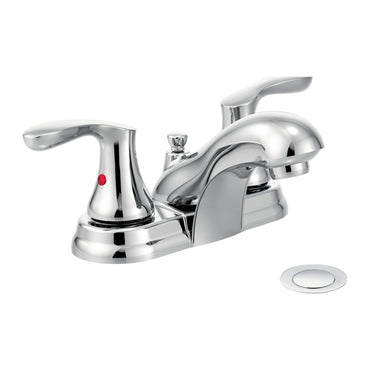
Quick answer: Vintage bathroom faucets bring curved spouts, separate handles, and older-style metal finishes to a sink without requiring old plumbing. Choose by the sink's hole count and spacing first, then compare spout reach, countertop thickness, supply connections, and drain parts. A faucet with the right appearance still will not work if its mounting hardware cannot pass through the existing holes or its spout sends water onto the rim.
For an existing vanity or remodel, identify the mounting layout and handles before deciding what needs a plumber. The sink determines which faucet bases can mount.
Compare your measurements and photos of the sink above and below with the traditional and two-handle bathroom faucets available for your sink. Keep both photos beside the listing.
What Is a Vintage Bathroom Faucet?
A vintage bathroom faucet is a sink fixture with shapes associated with older bathrooms, such as separate handles, a curved spout, and round decorative bases. The term may refer to an actual old fitting or to a current fixture made in an older style. Appearance does not tell you which mounting holes or supply fittings it needs.
Actual antique fixtures can have worn valve seats, hardened washers, and replacement components that are difficult to identify. Vintage style bathroom faucets made for current installations are usually simpler to fit into a remodel, but the mounting layout still controls your choice. A cross-shaped grip looks traditional; a short lever needs less twisting and may be easier for someone with limited hand strength.
Choosing a Farmhouse Bathroom Faucet for Daily Use
Choose a farmhouse bathroom faucet by matching the sink holes and selecting a spout that places water inside the bowl. Farmhouse fixtures often use a curved spout, separate handles, and finishes paired with painted cabinets or wood. The style describes the appearance, not a particular mounting pattern.
High-arc spouts leave more room for rinsing hands or filling a small container. They can also splash if the stream lands near the front of a shallow basin. For a small guest bath, compare spout height and horizontal reach with the bowl's depth and drain position instead of choosing the tallest spout.
Which Finish Suits an Antique Bathroom Faucet?
Oil-rubbed bronze gives an antique bathroom faucet a dark brown appearance; brushed nickel gives a muted silver tone, and chrome reflects light brightly. A rustic bathroom faucet often uses darker metal against a wood vanity, while nickel works beside muted silver towel bars. A curved spout and two handles can read as traditional even in chrome.
Compare finishes in daylight at the vanity rather than relying on a color name. Two products both called bronze can differ in darkness, surface texture, and highlights. A close color match matters most when the faucet sits near an existing drain flange, mirror frame, or wall fixture.
Match Vintage Bathroom Faucets to Modern Sinks
Yes, vintage bathroom faucets can fit modern sinks when their hole count, center spacing, mounting depth, and supply connections match the fixture. The sink's age does not determine the fit. Look under a broad existing faucet plate to find hidden holes before ordering a replacement.
A compact three-hole sink often has 4 inches between the centers of its outer holes, which suits many centerset faucets. Widespread faucets use a separate spout and handles; 8 inches is a common spacing, but each faucet has its own allowed range. A single-hole sink needs a single-hole mounting arrangement, not merely a smaller plate.
| Existing Setup | What to Identify | Replacement Decision |
|---|---|---|
| One hole in the deck | Hole diameter and room behind it | Choose a single-hole mounting base. |
| Three holes, 4-inch outer centers | Distance from outer hole center to center | Compare with a 4-inch centerset mounting pattern. |
| Three holes spaced farther apart | Exact outer center distance | Choose a widespread faucet rated for that spacing. |
| Long plate over the sink | Number and locations of holes beneath the plate | Match the holes or use a plate that fully covers unused openings. |
| Spout and handles on the wall | Valve and pipe positions behind the wall | Use a wall-mounted system; have a plumber identify the connections. |
Compare the faucet's permitted hole spacing with centers measured at the sink. Drilling new holes in porcelain risks cracking it.
What Should You Measure Before Ordering?
Measure the mounting holes, deck thickness, spout position, and plumbing connections before ordering a traditional sink faucet. A tape measure, flashlight, and phone camera are enough to collect most of the information. Record dimensions in inches and keep the photos beside the listing while you choose.
- Count the mounting holes from beneath the sink, including openings concealed by the old faucet plate.
- Measure between the centers of the outer mounting holes, not the edges of the faucet bases.
- Measure the deck thickness and available space underneath for mounting washers and nuts.
- Check the distance from the spout mounting hole to the basin's inner rim and drain, plus clearance to the backsplash.
- Photograph both shutoff valve outlets, hose connections, and any rigid supply tubes inside the cabinet.
- Note the drain opening, the sink overflow hole if present, and the stopper linkage under the basin.
Spout reach runs horizontally from the mounting center to the outlet; the stream needs to land inside the bowl. Compare faucet height and handle swing with the mirror, shelf, and backsplash.
Compare both ends of the supply hoses: the faucet inlet size does not determine the shutoff outlet size. A replacement pop-up drain must also suit the sink's overflow and connect to its trap.
Which Moen Fixtures Fit Your Bathroom?
Moen's traditional sink faucets address vanity replacements, while M-CORE shower trims require matching valves concealed in the wall. Select the sink faucet by its mounting and drain arrangement; select shower trim by the valve family already installed. A common finish or collection name does not make the internal connections interchangeable.
For a vanity with a dark metal finish, the TV6405ORB Belfield is an oil-rubbed bronze, two-lever, high-arc bathroom faucet. It has 1/2-inch IPS connections, Duralock quick-connect installation, and a non-metal pop-up waste assembly, so compare both the faucet inlets and sink drain before ordering.
For a lighter finish, the TV4524BN Wynford is a brushed nickel two-handle high-arc bathroom faucet with a valve included. It has 1/2-inch IPS connections, the Duralock quick-connect system, and a pop-up waste assembly; the Wynford description lists cross and lever handle styles, so look at the pictured handle configuration.
For a reflective finish alongside chrome hardware, the 84349 Caldwell is a chrome two-handle high-arc bathroom faucet. Choose it only after comparing the sink's hole centers, mounting room, and spout reach with its listing.
For shower trim, identify the valve manufacturer and series behind the handle before ordering; an attractive plate cannot establish the fit. Shut off the shower water supply before removing any handle or cover plate.
For a brushed nickel shower, the UT2282EPBN Dartmoor is an M-CORE shower-only trim with a rainshower head, arm, and flange. It is not a tub-spout kit; confirm on the spec sheet that the installed M-CORE valve series matches this trim before ordering.
The UT3312EPBN Belfield is a brushed nickel M-CORE shower-only trim with a rainshower head, arm, and flange. Its lever controls both volume and temperature, so choose it only for a matching M-CORE valve rather than an unrelated wall valve.
For a shower with outlets that need switching, the UT5500 Wynford is a chrome M-CORE 3-Series valve trim with an integrated transfer control. The diverter is built into this trim, so ask your plumber to confirm the installed M-CORE 3-Series valve and the outlet piping before choosing it; trim alone cannot add a second outlet.
Can You Replace a Sink Faucet Yourself?
A deck-mounted faucet replacement is manageable if both shutoffs work and the mounting nuts release. Gather a basin wrench, adjustable wrench, flashlight, bucket, and towels. Have a plumber repair a leaking or stuck shutoff before disconnecting lines.
Close both shutoffs, open the tap to confirm water stops, and place a bucket under the hoses. Disconnect the supplies and drain linkage, then loosen mounting nuts with a basin wrench. Forcing corroded nuts can crack porcelain or piping.
Lift out the old faucet, remove residue without scratching the sink, and position the new gasket and hardware as instructed. Tighten mounting nuts evenly, reconnect hoses without twists, and keep the drain linkage clear of supply tubes.
Open the shutoffs slowly and touch each dry joint with tissue to detect drips. Test hot and cold flow, fill the basin, release the stopper, and inspect the trap as it drains. Shut off water again if a joint leaks.
Have a plumber handle seized fittings, broken shutoffs, damaged pipes, or a shower valve that requires different concealed plumbing. A valve replacement may need access through the wall, while compatible trim can often be removed from the room side.
Which Mistakes Create Extra Plumbing Work?
The mistakes that cause the most rework are hidden mounting mismatches, poor spout placement, bad drain choices, and assumptions about shower valves. Each can be identified before the old fixture is removed.
- Buying for the visible plate alone: hidden sink holes leave the new faucet unable to mount without another fixture or cover plate.
- Ignoring spout reach and handle clearance: water strikes the bowl rim or a handle hits the backsplash, forcing a different faucet choice.
- Keeping cracked or corroded supply lines: damaged washers and fittings leak into the cabinet, risking swelling and water damage.
- Ordering the wrong pop-up drain: an overflow mismatch or poor tailpiece fit prevents a proper sealed drain connection.
- Treating shower trim as a new valve: a handle and plate will not operate an unrelated concealed valve, creating a need for different trim or plumbing changes.
For an existing vanity, select vintage bathroom faucets that match the holes and place the stream inside the basin. For a new sink, choose the faucet layout before ordering a predrilled countertop. For a shallow bowl, prioritize a suitable spout reach over maximum height. For an older shower, identify the valve first so replacing visible trim does not turn into an unexpected wall repair.
Frequently asked questions
What Finish Looks Vintage in a Bathroom?
Oil-rubbed bronze gives a dark brown aged-metal appearance, while brushed nickel has a softer silver tone. Chrome also suits traditional rooms, especially alongside existing chrome towel bars and mirrors.
Are Cross Handles Vintage Style?
Yes, four-armed cross handles are associated with older sink fixtures. They twist to open and close the valve, so a lever may be easier if gripping small handles is difficult.
Do Vintage Faucets Fit Modern Sinks?
Yes, traditional-looking faucets can fit modern sinks with matching mounting holes and adequate clearance below the deck. Measure hole centers and compare the shutoff and faucet connections before ordering.
What Is a Farmhouse Bathroom Faucet?
A farmhouse bathroom faucet is a traditional-looking sink fixture commonly using a curved spout, separate handles, and muted or dark metal finishes. The name describes its appearance, not a specific hole spacing or plumbing connection.
Ready to choose? Browse our Bathroom Faucets collection at Aqualux Studio.
Related reading
- Moen Commercial Faucet: Choose the Right Sink and Shower Parts
- Bathroom Fixture Sets: Match Your Sink, Shower, and Tub Trim
Written by John Plumber, an experienced plumber who shares his personal opinion and hands-on experience.
This article reflects personal experience, not step-by-step instructions. Always follow the manufacturer's installation guide for your exact model, and hire a licensed plumber if you are not sure. Questions or corrections: support@aqualux.studio.