Quick answer: Most Moen shower valve noise comes from a worn or dirty cartridge, not the valve body. Replace or clean the cartridge to stop squeals, whistles, or chatter that change with handle movement. Banging or humming usually indicates plumbing or pressure issues, while new trim only refreshes appearance and doesn’t silence a bad cartridge.
Most moen shower valve noise comes from the cartridge, not the valve body behind the wall. A squeal, whistle or chatter that changes as you move the handle almost always points to a worn or dirty cartridge, and a new cartridge or a cleaning fixes it. Banging when the water shuts off, or humming you can hear at other fixtures, usually points to the plumbing system rather than the valve. A new rough-in valve is the right call only when the body itself is damaged, the connections leak or corrode, or you are opening the wall anyway.
New trim falls in between. It won't silence a noisy cartridge by itself, but it is a sensible purchase when the handle and escutcheon are worn, when you want a new look, or when you are replacing the cartridge on a valve platform that still has plenty of life left. The sections below help you narrow the cause and match any replacement to what is already in your wall.
-


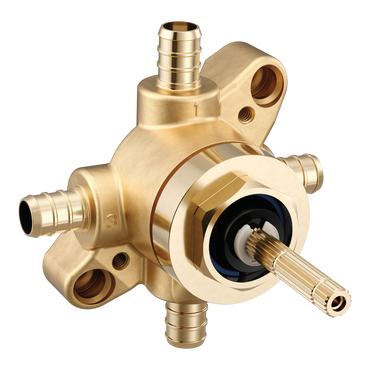
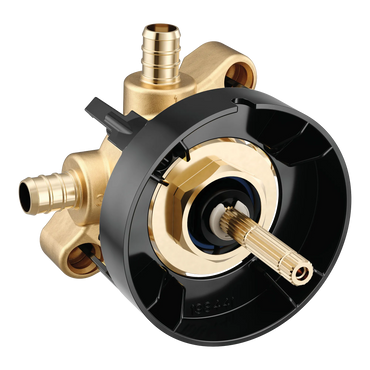
Moen 3360 Commercial Three-Function 1/2" Transfer Valve
$49.99$49.99 -


Quick Diagnosis of Moen Shower Valve Noise
Start by noting when the sound happens. A high-pitched squeal or whistle that changes pitch as you rotate the handle comes from water squeezing past a worn or partly blocked passage in the cartridge. A rattling or chattering sound at certain temperature settings often comes from the pressure-balancing spool inside a Posi-Temp or M-CORE cartridge, which can stick or vibrate when scale or debris builds up.
A loud bang or thud right when you shut the water off is water hammer. It happens when fast-moving water stops suddenly and loose pipes slam against framing. The cartridge is rarely to blame here. Look for missing pipe straps, an undersized or failed water hammer arrestor, or high house pressure.
Next, run a sink or tub filler elsewhere in the house. If you hear the same hum or vibration there, check your static water pressure with an inexpensive gauge on a hose bib. Most homes run between 40 and 80 psi, and many plumbing codes call for a pressure-reducing valve when pressure goes above 80. A failing pressure-reducing valve can cause humming throughout the house, and no shower part will cure it.
| Issue | Likely Cause | Recommended Fix |
|---|---|---|
| Squeal or whistle that changes with handle | Worn or dirty cartridge | Replace cartridge or clean and lubricate |
| Rattling at certain temperatures | Scale or debris in pressure-balancing spool | Clean cartridge or replace cartridge |
| Bang when water shuts off | Water hammer from loose pipes or missing arrestor | Secure pipes, add/repair water hammer arrestor, check pressure |
| Hum throughout house | Excess static pressure or failing pressure-reducing valve | Install or service pressure-reducing valve |
| Worn or cracked trim | Cosmetic wear or damaged escutcheon | Install matching trim kit on same platform |
When a Cartridge Repair Is Enough
If the noise is limited to the shower and changes with handle position, the cartridge is the first suspect. Turn off the water at the integral stops on the valve if it has them, or at the main shutoff if it doesn't. Pull the handle and escutcheon, remove the retaining clip or nut, and pull the cartridge. Debris after recent plumbing work, mineral scale in hard-water areas and dry O-rings are all common findings.
Sometimes flushing the valve body and applying a thin coat of silicone plumber's grease to the O-rings quiets things down. In most cases, though, a cartridge that has started squealing is worn. A genuine replacement for your valve type is a modest purchase and usually solves the problem for years. Buy the exact cartridge for your platform. Moentrol, Posi-Temp and M-CORE cartridges are not interchangeable.
A repair is also enough when the valve body is solid, the stops open and close cleanly, nothing is leaking inside the wall, and you like your existing handle and plate. In that case, skip the remodel and replace only what is worn.
Signs a Replacement Is the Better Buy
New trim makes sense when the finish is pitted or peeling, the handle is cracked, or the escutcheon no longer seals against the wall. Because trims are built for a specific valve platform, you can change the look without opening the wall as long as you stay on the same platform. For a standard Posi-Temp tub and shower valve, a kit such as the T62133EP Eva trim swaps the visible parts in an afternoon.
A new rough-in valve is the better buy when the cartridge is seized and the body is damaged trying to remove it, when the valve body or its connections leak or are badly corroded, or when the integral stops no longer shut off. It also makes sense if you have an old two-handle valve with no pressure balancing, which leaves you exposed to sudden temperature swings. And if the tile is coming off for a remodel, replacing an aging valve now costs far less than opening the wall again later.
Noise alone almost never justifies a new valve. Treat a valve replacement as the fix for a failed body or a planned upgrade, not as a cure for a squeal.
Identify the Valve You Already Have
The way your handle works is the fastest clue. On a Moentrol valve, you pull the handle out to turn the water on and control volume, then rotate it to set temperature. On a Posi-Temp valve, you rotate a single handle counterclockwise from off, through warm, to hot, with no separate volume control. M-CORE is Moen's newer platform. Depending on the series, it offers a single temperature handle or stacked temperature and volume controls, and many M-CORE trims carry a UT prefix in the model number.
With the handle off, look for a model stamp on the valve body or a cap. Also note whether the valve has integral stops, which are small screwdriver-slot shutoffs on either side of the cartridge. If you can see the pipe connections through the wall opening or from an access panel, record the type: copper sweat, threaded IPS, crimp ring PEX or cold expansion PEX.
That connection type decides which rough-in you buy. For a Posi-Temp replacement on a PEX system, the 2580 uses 1/2-inch crimp ring PEX, while the 2385PF uses 1/2-inch cold expansion PEX. Both are M-PACT Posi-Temp valves that accept Posi-Temp trims, so you can keep using compatible trim options. Choose the one that matches the tools and fittings your plumbing already uses.
Matching Trim, Spout and Wall Opening
Single-handle shower valves need only one wall opening, so the key fit check is the escutcheon. The new plate must fully cover the existing hole in your tile. Measure the opening and compare it with the plate dimensions on the spec sheet. Hole sizes vary by valve type and by how carefully the tile was cut, so measure your own wall rather than assuming.
For a tub and shower combination, look at the spout too. Moen spouts typically connect either by slip-fit onto a copper stub or by threads onto a 1/2-inch IPS nipple. The stub-out length from the finished wall matters as well, and the acceptable range depends on the spout model. Check the spout's spec sheet against what you measure.
Keep the platform consistent. A Posi-Temp trim belongs on a Posi-Temp valve, and an M-CORE trim needs an M-CORE valve of the right series. Mixing them leaves you with a handle that won't fit or a valve that won't function correctly.
What to Check Before Ordering
Confirm your valve platform from the handle operation and any markings. Note whether you need a tub spout, a showerhead or both. Measure the wall opening and the spout stub-out. Check the pipe connection type if you are buying a rough-in valve. Then read the product page to see whether the item is trim only or includes the valve, and whether the cartridge comes with it.
The Bottom Line on a Noisy Moen Valve
A squeal or chatter that follows the handle is a cartridge problem, and a genuine replacement cartridge is usually all you need. Banging at shutoff or house-wide humming is a pipe or pressure problem, so fix that first. Buy new trim when the visible parts are worn or you want a new look on the same platform. Buy a new rough-in valve, matched to your Posi-Temp, M-CORE or Moentrol needs and your PEX or copper connections, only when the body has failed or the wall is already open.
Ready to upgrade? Browse our Shower Valves & Rough-In collection at Aqualux Studio.
Related reading
- Moen Shower Valve Vibrates: Pressure, Cartridge or Piping?
- Moen Kingsley Shower Valve: Matching Legacy Trim and Controls
- Moen Shower Valve Replacement Cost: Valve and Trim Prices vs Labor
Written by John Plumber, an experienced plumber who shares his personal opinion and hands-on experience.
This article reflects personal experience, not step-by-step instructions. Always follow the manufacturer's installation guide for your exact model, and hire a licensed plumber if you are not sure. Questions or corrections: support@aqualux.studio.