

Quick answer: Typical tub filler flow rates range from 3 to 5 gallons per minute; anything slower usually means debris, a partially closed stop, or an undersized valve. Measure your actual rate by timing a 5-gallon bucket, then compare it to the valve’s spec sheet. If it’s below spec, clean or replace the cartridge, or install a larger Moen valve.
If your bathtub takes 20 minutes or more to fill, the cause is usually one of three things: a restriction you can clear, a worn cartridge you can replace, or a valve that was never sized for the tub. A low tub filler flow rate caused by debris, partly closed stops, or mineral buildup is a repair job. A slow fill caused by a small or aging valve feeding a large soaking tub usually means a new valve, and often new trim, is the better buy.
The quick math helps. A standard alcove tub holds roughly 35 to 45 gallons to the overflow, and a deep soaking or Roman-style tub can hold 50 to 80. At 5 gallons per minute, a 60-gallon tub takes about 12 minutes. At 3 gallons per minute it takes 20. Time how long your faucet takes to fill a 5-gallon bucket with both handles fully open, divide 5 by the minutes, and you have your real-world flow rate to compare against the spec sheet.
-

 13% off
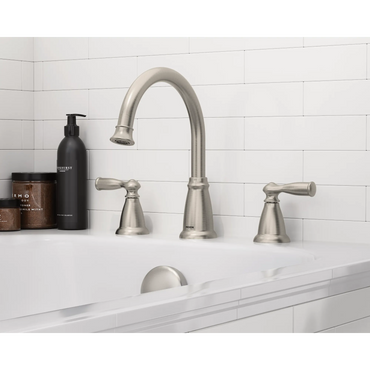
Moen T4943BN Brantford Brushed Nickel 2-Handle Low Arc Roman Tub Faucet
$88.99$88.99 $102.68 -


Quick Diagnosis for Slow Filling
Start with the easy checks. Make sure the shutoff stops under the deck or behind the access panel are fully open, since a stop turned only partway is a common culprit after any plumbing work. Then compare hot and cold separately. If only one side is weak, the problem is almost always on that side, such as a clogged cartridge inlet, a partly closed stop, or a failing supply line.
If both sides are slow, check the rest of the house. Weak flow at every fixture points to low municipal pressure, a pressure-reducing valve set too low, or corroded galvanized pipe, and no new faucet will fix that. If the kitchen and shower run fine but the tub crawls, the tub valve, its trim, or the supply piping to it is the bottleneck.
One more clue: if the tub fills at a decent pace but turns lukewarm halfway through, that is a water heater capacity issue, not a flow problem. A 40- or 50-gallon heater can struggle to fill a large soaking tub with hot water, regardless of the valve.
| Issue | Likely Cause | Recommended Action |
|---|---|---|
| Low flow in bucket test | Debris, mineral buildup, partly closed stop | Clean inlet screens, open stops, soak cartridge in vinegar |
| One handle weak | Clogged cartridge inlet or failing supply line | Inspect and replace cartridge |
| Both handles weak | Low municipal pressure or pressure-reducing valve set low | Check house pressure, adjust PRV |
| Fill slows midway, lukewarm | Water heater capacity too small | Upgrade heater size |
| Very slow fill in large Roman tub | Valve undersized for tub volume | Install larger valve (e.g., Moen S3371 3/4-in ExactTemp) |
| Corroded or cracked valve body | Age or damage | Replace valve |
When a Repair Is Enough
If flow dropped gradually over months or years, mineral scale and debris are the likely cause. Shut off the water, remove the handle and trim, pull the cartridge, and inspect the inlets and any screens for grit. Soaking parts in white vinegar and flushing the valve body by briefly opening the supply with the cartridge out can restore much of the original flow.
A cartridge that is stiff, drips, or no longer opens fully should simply be replaced. Moen cartridges are designed as serviceable parts, and swapping one is a common afternoon job. If the valve body is sound, the stops work, and the finish still suits you, a new cartridge is the most sensible fix.
Clear Signs a Replacement Is the Better Buy
Replacement makes sense when the valve itself limits flow. Most residential pressure-balancing valves on 1/2-inch supply deliver somewhere around 4 to 6 gallons per minute to a tub spout at typical household pressure, while Roman tub valves and larger thermostatic valves can deliver noticeably more. Check the spec sheet for your exact model, because ratings vary. If you installed a bigger tub and kept the old valve, the fill time will reflect that mismatch no matter how clean the cartridge is.
Other good reasons to replace include a corroded or cracked valve body, stops that will not seal, an older valve whose parts are hard to find, or a remodel where you want a new style or finish anyway. If you are opening the deck or wall regardless, putting in a properly sized valve now costs far less effort than doing it twice.
Identify What Is Installed Before You Shop
For a deck-mounted Roman tub faucet, count the holes and measure center to center between the outer holes. Two-handle Roman tub faucets commonly fit spreads in the 8 to 16 inch range, with a third hole for the spout and sometimes a fourth for a hand shower. These trims mount onto a separate Roman tub rough-in valve, so confirm the new trim is compatible with the valve already under the deck. A trim such as the T4943BN Brantford two-handle low arc faucet is sold as trim, which means the rough-in valve must match.
For wall valves, identify the type. Moentrol valves are older single-handle valves where you pull to turn on and rotate for temperature, with volume control built in. Posi-Temp valves rotate in one motion and control temperature but not volume. M-CORE valves are Moen's current platform, and M-CORE trims are designed to swap across compatible M-CORE valves, which simplifies future style changes. The valve type determines which trims will fit.
Also note the connection type: threaded IPS, sweat (copper), PEX crimp, or PEX expansion, plus pipe size. If you are replacing the valve to increase flow, a 3/4-inch supply makes a real difference on large tubs. The S3371 ExactTemp 3/4-inch IPS thermostatic rough-in valve with check stops is built for that situation. A thermostatic valve sets temperature only, so it pairs with a volume control such as the TS3600 ExactTemp volume control to turn the flow on and off and adjust it.
What to Check Before Ordering
Confirm your measured flow rate and your tub's capacity, then compare them with the flow rating on the new valve's spec sheet. Verify the hole count and spread for deck trims, the valve platform for wall trims, the inlet connection type and size, and the spout reach so water lands in the tub rather than on the rim. Check local code for anti-scald requirements on your installation, confirm your water heater can supply the volume you plan to use, and make sure you have access to the valve through a panel or deck opening before you commit.
The Bottom Line on Slow Tub Fill
Time a bucket fill first. If the flow rate sits close to what the valve is rated for, cleaning won't help much and a larger valve is the real fix. If it falls well below the rating, open the stops, clean or replace the cartridge, and retest before buying anything. When a deep tub is fed by a small valve, matching a properly sized rough-in with compatible Moen trim is what finally shortens the wait.
Ready to upgrade? Browse our Roman Tub Faucet collection at Aqualux Studio.
Written by John Plumber, an experienced plumber who shares his personal opinion and hands-on experience.
This article reflects personal experience, not step-by-step instructions. Always follow the manufacturer's installation guide for your exact model, and hire a licensed plumber if you are not sure. Questions or corrections: support@aqualux.studio.
Related reading


